Skip to content
Smuggler’s Tales
 It was the Roaring Twenties. The Volstead Act (Prohibition) put an end to Grandpa’s after-work gin and tonic and Great Aunt Milli’s Manhattan at her private country club. Yet imbibers of hard liquors would not be denied.
In Chicago, Al Capone, one of the nation’s most notorious gangsters, raked in millions smuggling alcohol and opening underground saloons and gambling joints called speakeasies. To the south, the banished booze distilled in the Caribbean flowed freely into South Florida, turning family beaches from Miami to West Palm Beach into dangerous and clandestine ports of call.
It all started with the Ohio-based Women’s Christian Temperance Union (WCTU) in 1873. The group labeled drunkenness “a national curse” and advocated abolishing the trafficking of alcohol. Joined by the Anti-Saloon League (ASL) in 1900, the movement endorsed political candidates and vigorously lobbied for anti-saloon legislation. They were so effective that by 1916, 23 of 48 states had adopted its platform. By January 1919, the states ratified the 19th Amendment and a nationwide ban prohibited the manufacture and transportation of liquor.
But the legislation had loopholes. The law defined intoxicating liquor as having a .5 percent alcohol content, yet liquor used for medicinal, sacramental or industrial purposes, no matter the alcoholic content, was still lawful. And home brewed beverages made from fruit or grapes were also permitted. To further exacerbate the situation, law enforcement had little funds with which to enforce the legislation. Thus, organized crime seeped relentlessly through the cracks.
Moonshine stills guarded by shotgun toting lookouts dotted the back woods. Drivers called “bootleggers” delivered the distilled hooch to family, friends, private clubs and speakeasies. Soon the moniker was applied to anyone running illegal booze including imports from Canada, the French islands and the Bahamas. Speakeasies became widely popular. So named because patrons had to “speak easy” to convince the doorman to let them in, the establishments were a haven for illegal gambling and the consumption of alcohol.
In West End, Bahamas, corrugated metal shacks lined the beach where thousands of bottles of liquor were warehoused and bagged for transportation into South Florida. Bottles were fitted into straw jackets and a half dozen placed in burlap bags known as “hams.” Pushcarts on rails carried the hams to docks where they were loaded onto boats whose gunwales barely cleared the water. The armada of 18-20 boats then made its way across the 55-mile straight to secluded beaches on the South Florida coast.
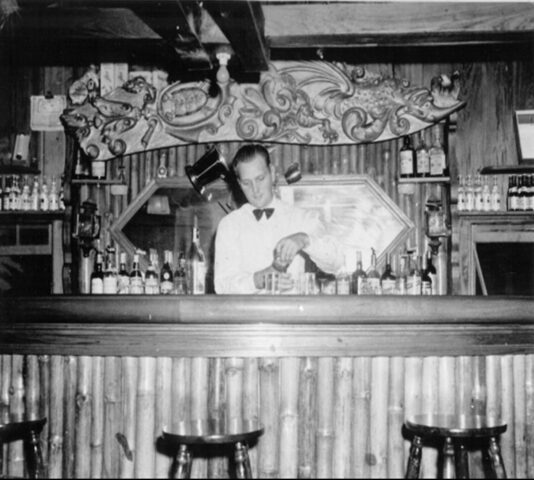
One destination was Cap’s Place, a restaurant located on the Intracoastal Waterway in Lighthouse Point. Built in 1928 and still serving customers, the establishment was originally known as Club Unique and became a popular supper club and gambling casino during the 1930s and 1940s. Captain ‘Cap’ Theodore Knight, one of the earliest settlers in the Lighthouse Point area, owned the trendy club and along with his wife, Lola, become heavily involved in rum running.
Cap ran whiskey from Bimini, Bahamas back to his restaurant by night, using the beacon from the Hillsboro Lighthouse as reference. His liquor runs had a flawless record due to his skills as a navigator and the fact that he had faster boats than the Coast Guard. Additionally, his brother is said to have signaled when the coast was clear by flashing a go ahead from the lighthouse. Cap tied the whiskey to buoys with long ropes then sank the contraband in Lake Placid, a wide area on the Intracoastal in front of the club. When a customer placed an order, Cap rowed out to a buoy and brought back the bottles for use in the restaurant or delivery to customers in town. In a 1973 interview, Lola Knight recalled their rum running days: